Search This Blog

Friday, January 13, 2017

Childish Pursuits

The things that intrigued and inspired us when we were children still have that power over us today.

As I child I was an avid beachcomber. Living so close to the beach it was easy for me to simply walk a few blocks away and explore the tide line for perfect tiny shells and sea glass. These were true treasures for me.

Here are some ocean treasures I collected when I was 7 years old. I kept them in a special box and as an adult I embedded them in the walls of my seaside themed bathroom. 


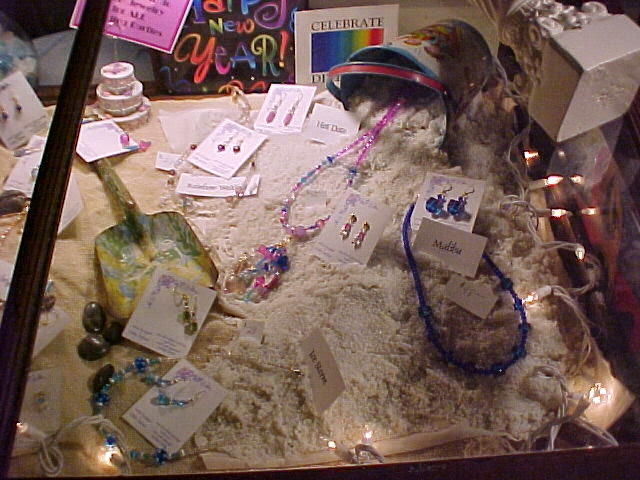
Here's a display of my jewelry, some of which I made from sea glass.


One afternoon, when I was a kid, I sat in the yard of the little girl who lived across the street. There were four of us children colouring with crayons in our colouring books. My book was Aladdin and the Magic Lamp. 

I was the kind of kid who coloured the entire page, from edge to edge, until the paper was stiff with wax.

I ran out of pages to colour, so I went home and got blank sheets of paper on which to draw. I continued the story. I invented a story about myself as a magic princess who could do anything she wanted. 

The other children stopped colouring in their books and asked if they could colour the drawings I was creating instead.

One little girl said, "I'll give you a nickel for that picture."

Another said, "I'll buy you an ice cream if you let me colour this one."

A little boy offered, "I'll let you borrow my lizard for a week if you draw a picture for me." 

It was at that moment, at age five and a half, that my professional career as an Artist began. I discovered that if I do what I love to do, I will have money, food, and maybe the loan of a lizard for a week. 

I have not regretted the choice.

Sunday, January 8, 2017

The Eloquence of Possibility


There they are, in that jumbled pile. The half done projects, the special tools and materials for that particular project that was somehow never completed. The artwork that is almost finished, but not quite.

On my workspace are dozens of works in progress. Any one of them could be completed with a bit more time, but there they are, half formed and unfinished.

They haunt me. And I, I am all excuses and reasons. I'm not in the mood, the light is wrong, my back hurts, my eyes are tired.

If it was a paid commission I would wait until I was down to the wire, then at the last possible moment I would find myself in a frenzy of creativity, spurred by the fear of the deadline. 

But these are my own projects, not made for a patron or a customer, but self motivated pieces of art that have no destination. They may never be framed, printed or sold. They are the pieces which I do for myself.

Without the impetus of a deadline, my work sputters and comes to a standstill. A simple obstacle becomes a reason to stop. It stagnates and just sits there, mute testimony to my lack of engagement. 

Or is it?

What if inside that pile is the next great work of my life?

As I look back over decades of being an artist, I realize that every great work began with an unfinished painting, something that I set aside but couldn't discard.

To me, the unfinished painting is eloquent with possibility. 

And that thought alone is enough to make me reach for the paintbrush. 

Monday, December 5, 2016

Messy Energy


I am in the middle of a project. It's one of those many days, lots of steps, multi-procedural projects. My studio looks like an explosion in an at school.

Although I believe in going with flow, I also believe that a well rested mind functions best, so I reluctantly put my tools down to prepare for bed.

Brushes must be cleaned. My pallet must be tidied. Dirty water must be dumped, the bowls must be scrubbed. Soiled paper towels are placed in the rubbish, fresh ones are laid out.

I am preparing my work space for tomorrow's endeavors. When I enter the studio, I want all to be in readiness for my work. 

Yet, as I make my way to my bed, my mind is not so easily tidied away. Thoughts rush one on another. Images appear in my mind's eye.

I keep my notebook and colored pencils next to my bed. I make quick visual notes, in my own personal shorthand of imagery. 

“When you do something you should burn yourself completely, like a good bonfire, leaving no trace of yourself.” ~Shunryu Suzuki

This philosophy applies to both the creative act itself as well as to good studio practice.  Yet sometimes a bonfire burns for days, even weeks. 

When I work on a project that takes days, I find that I must establish a rhythm of working, and a routine. The routine makes it possible to return to the piece the next day with minimum fuss.

Decades of work have taught me to lay out my tools and materials just so, like a matter chef preparing a meal. The French concept for this in cookery is "mise en place"...everything put in its proper place. It's both a noun and a verb.

As artists, our mise en place is both the physical studio set-up and the mental preparation necessary to work. This allows the flow of creative energy to begin almost as soon as we enter the studio. The knowledge that all is in readiness allows us to contemplate the work even before we arrive at the studio. 

It's morning. I enter my studio. My tools and materials greet me, invite me in to continue my work. It's going to be another busy day. 


Sunday, July 31, 2016

Percolation


We all go through dry spells, when we create nothing. Illness, grief, exhaustion, fear, emotional upheaval, family crises, there are so many reasons to be in the desert.

The very awareness that we are not creating brings us guilt, which itself inhibits creation.

I can't solve your desert. But I can share with you how I deal with mine.

1. I collect random ephemera throughout my day. I have a place to store it. Periodically I sift through it. Nothing may click right now, but it has percolated through my mind, and something creative will result.

2. I go to inspirational places. My current place is Venice. The architecture, the light in the water, the colour of the water, it all speaks to me. Find a place, do what you must, sacrifice as you can, go there. Be there. Spend time there.

3. I reorganize my studio. Seeing it afresh sometimes sparks my creative tinder. Just touching my tools and materials can pull me to create.

4. I go where there are other artists. I eat where they eat. I read where they read. Is as if there is an air of creativity floating through the area.

5. I buy myself beautiful flowers. Walking through city streets with a bunch of beautiful flowers is somehow very empowering. Strangers admire you, or admire the flowers. You feel good about that. Silly, I know, but it does work.

6. I make a firm commitment to do a five minute sketch every day. What's five minutes? An easy commitment to keep.

7. I give away sketches. To strangers on the bus, to my waitstaff, to the people behind the counters. It's a little thing for me, but it may be the only piece of original art they have ever owned. It's a really big  thing for them.

8. I keep my phone camera on and take photos of things I see on the street. Nothing amazing, just ordinary things. Really powerful exercise, as it turns out.

9. Art engenders art. I go to the museums and spend time with art. I visit galleries and craft shops.

10. I forgive myself for not creating right now. We all dwell in the desert sometimes. Just remember, though, that the rain which falls percolates through the sand to become refreshing water of life.

Monday, February 9, 2015

Embracing Chaos

Nanny Wisdom:
They say that there's a place for everything and everything in its place. 


This may be true for some things, but it may not always be true for my studio.

I keep a photo of my studio at its pristine best to remind myself of how good it can be when there is a place for everything and everything is in its place. Periodically I literally hold the photo up against my studio to compare the differences.

Everyone wants a clean and organized studio. That's the picture artists submit to magazines to show their studios at their finest. That's the model for which all we long.

But is it the best way to work?
 
I still do the things I did when I was eight years old, because I'm still me. It's in my nature to draw and paint, make music, explore new places and leave my stuff in a chaotic pile.

The inside of my bag today looks exactly like the inside of my school bag fifty years ago.


Recently I had a jewelry show. I ransacked my jewelry workspace to find the beads I needed to replenish stock, and in doing so, I inadvertently arranged boxes of beads which had never been together before.

Suddenly I saw new necklaces, waiting to be made.

They were made out of the beads I have used for years.

But in the new combinations created by randomly placing boxes of beads together which would otherwise be in their "proper places", I saw new combinations of color and design.

The chaos forced me to see with new eyes.


Don't misunderstand me: I am inspired by the clean white counter, where I may begin a new project without having to dig through piles of other works and tools and materials. 

Having my materials at hand and at the ready is very freeing.


But there is something about the seemingly random interaction of materials that can really start my creativity flowing.

Did I put these things on this table or counter simply to free up some space in which to work? Or did I unconsciously place them together in the early stages of Creating Art?

The former answer makes me look good and virtuous. The latter answer is closer to the truth.

I take great delight in looking at and caressing my art tools and materials. There is creative energy stored up in them, waiting for my touch to free them.

I savor the unexpected combinations I see before me in the random chaotic mess.


Do I want to always live in chaos? No. I work best when I can quickly access the tools and materials I need.

But an occasional visit by chaos in my studio is a welcome change, and one which always engenders some exciting new art.

I embrace my chaos. That's where I lose my keys but find my muse.


Friday, October 31, 2014

Chasing Rainbows


The funny thing about chasing rainbows is that you can never get close enough to actually touch one, without getting wet, and just when you think you have located the rainbow's end, you are too close to see it. Rainbows are a longdistance-only experience. 

Many people embark on the creative life with the hope of making a living from it. They hone their skills and study the market in order to produce a product that will sell. 

Observing the numbers of art school graduates versus those who actually make a viable living with their art, it becomes quickly apparent that those who succeed as professional artists are in the minority. 

Some people study to become artists because the creative life seems attractive, it seems exotic and sexy and cool. They attend gallery openings, they aim to become famous. They intend to become rich. 

This is a trap.

At some point in this sort of creative life of producing art there comes a time when the seduced artist becomes a manufacturer. 

The gallery or the art director says something like "the clients really liked the blue one, can you do more of those?", or "they really liked the blue one but it's too big for their space, can you make a smaller version?", or "they love the blue one, but can you do it in orange to match their sofa?"

The focus of the creative impulse shifts from producing art for your own vision, to producing product to fulfill someone else's vision or needs.

Don't get me wrong, I admit that making a living by making my art is deeply satisfying,  but it is very hard to avoid those traps. 

Art without compromise means taking risks, exploring new and uncharted waters, letting myself be caught up in ever changing and evolving art forms, without fear. 

When I was working for eight years producing my book "Artist Afloat - A Sketch Journal of Britain by Canal" it soon became apparent that in order to make the pages flow with a similarity, a cohesiveness. 

I needed to determine and adhere to a specific palette and style. There had to be unity throughout the hundreds of illustrations for the book.

That proved hard to do, especially as time passed. Each new painting held new revelations for me, and I found it quite difficult to limit my growth to what I had already discovered in the making of the book.

Eventually I made a way to explore my work as an artist and to also keep the book's very many illustrations stylistically consistent.

Before embarking on a new illustration for the book, I made a separate painting just for myself, in a quite different style which reflected my current growth as an artist. 

After this, I went through my ever growing pile of book illustrations, studying them carefully, immersing myself in them. Then I created the next illustration in that style.

By allowing my natural growth as an artist to take form, I satisfied my need for self expression, and then I was free to go back to the familiar styles and techniques of my book. The resulting illustrations had a fresh and vibrant spirit to them without compromising the stylistic integrity of the book as a whole.

In taking the very real risk of being self employed, I was free to grow as an artist, ever trusting that my own creative vision would prove popular with enough souls in the world that I could support myself.

It wasn't always easy. It took about twenty years of struggling and hoping, taking poorly paying jobs on spec, before I finally found that my audience had grown, and commissions for work came with regularity and sufficient remuneration that life was no longer a struggle. 

Never stop chasing your rainbows. Persevere through the hard times, believe in the power of your own vision. Compromise when you must, but to find true happiness as an artist never relegate your work to the mere production of popular sentiment. Follow your own vision. 

Art is not about product, it is about process. That is what sells, the sudden lightening and cracking thunder of inspiration. 

That is the secret which compels customers to buy your work. They perceive in your work something that is ethereal, intangible and immortal.  They want to connect to that. They want to own it.

They too, after all, like all lovers of things that are mysterious, beautiful and true, are also chasing rainbows.